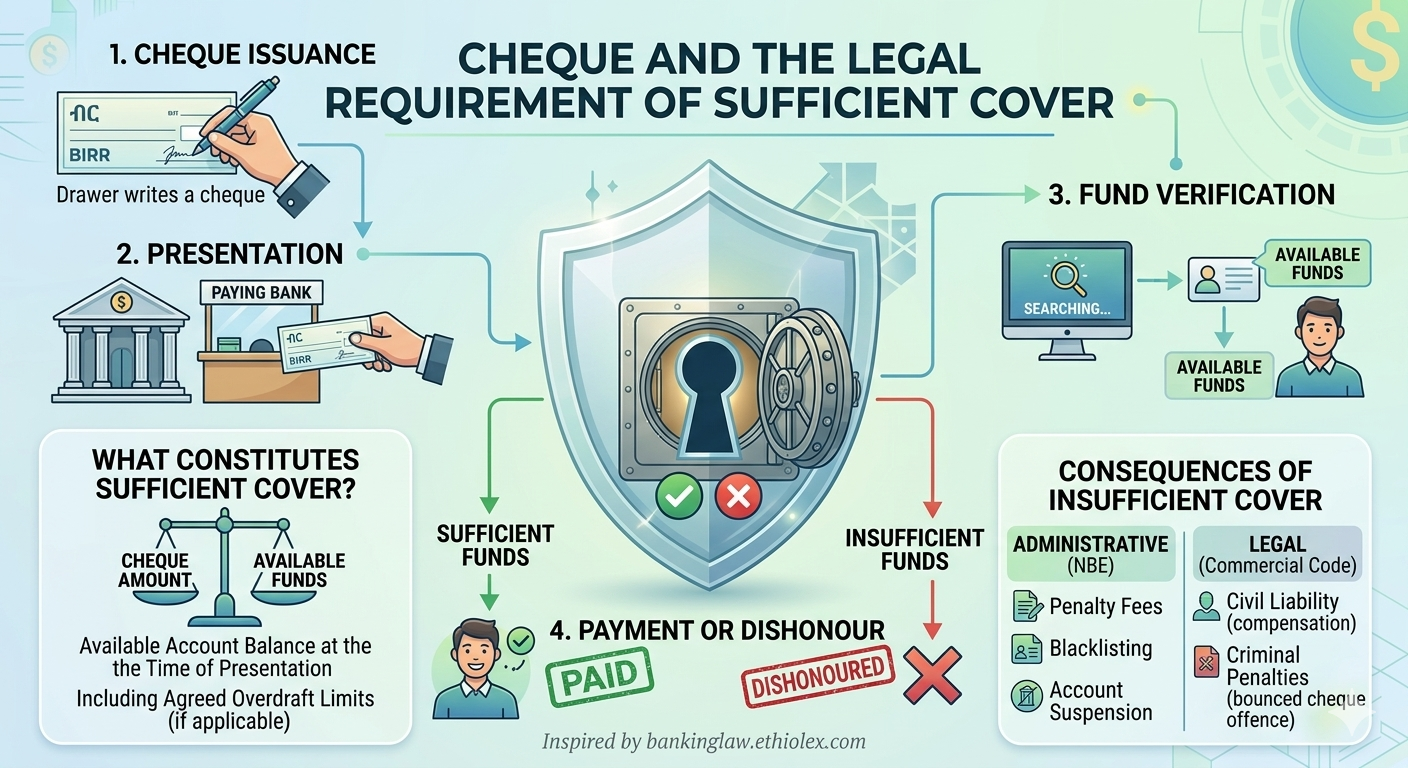

The Legal Definition and Requirement of Cover for Transfer Orders
In the regulatory framework of banking transactions, the concept of cover refers to the availability of sufficient disposable funds within a depositor's account to satisfy a specific payment instruction or transfer order. While the term cheque is often used in common parlance, the Commercial Code addresses these instruments under the broader category of bank transfers, specifically allowing for transfer orders that are presented to the bank directly by the beneficiary rather than the account holder. Under Article 903, a transfer is fundamentally a transaction where the bank debits the payer's account and credits the beneficiary's account based on written instructions. For such an instruction to be executable, the person ordering the transfer must have a credit balance or an agreed-upon credit limit that encompasses the total sum of the transaction. Consequently, the existence of sufficient cover is a prerequisite for the bank’s performance of the mandate, as the bank essentially acts as a mandatory for the customer.
The Bank's Statutory Right of Refusal
Article 908 establishes a critical protective mechanism for financial institutions by stating that where there is not sufficient cover, the bank may refuse to execute the transfer. This right of refusal is a discretionary power that allows the bank to decline any payment order, including those presented by a beneficiary like a cheque, if the account balance is inadequate to meet the debt,. Because the contract of deposit makes the bank the owner of the funds and creates a debtor-creditor relationship, the bank is only obligated to repay the funds under the specific conditions provided in the contract. If the account holder attempts to transfer more than the available balance, they are effectively requesting the bank to provide credit, which the bank is not legally required to do unless a separate agreement exists. Therefore, the bank's refusal for insufficient cover is the primary legal defense against the unauthorised creation of a negative balance.
Insufficient Cover and the Prohibition of Automatic Overdrafts
The legal basis for a bank's refusal of an instrument due to insufficient cover is further reinforced by Article 899, which explicitly stipulates that a contract of deposit of funds does not, as a matter of right, grant the depositor any entitlement to an overdraft. This means that the mere opening of a deposit account does not imply that the bank will honour payments that exceed the existing balance,. In the context of a cheque or a presented transfer order, if the account lacks the necessary funds, the bank is within its legal rights to dishonour the instrument immediately. Without an express credit agreement, any attempt by a depositor to issue a transfer order for a sum they do not possess is a breach of the operational expectations of the deposit contract, and the bank bears no liability for the resulting non-payment to the beneficiary,.
The Persistence of the Causal Debt and Legal Consequences
A critical distinction in the law regarding insufficient cover is the separation between the banking transaction and the underlying obligation it was intended to settle. Article 909 clarifies that the debt for the settlement of which a transfer order is issued shall subsist, along with all securities and collateral, until the account of the beneficiary is effectively credited with the amount. This means that if a bank refuses a transfer due to insufficient cover, the payer's original debt to the beneficiary is not discharged and remains fully enforceable. Furthermore, the beneficiary only obtains title to the sum at the precise moment the bank debits the payer's account. If the bank refuses the transfer because of a lack of funds, the transfer of title never occurs, and the payer remains the debtor of the beneficiary for the original amount,.
Finality and the Timing of Refusal
The bank's ability to refuse for insufficient cover is also tied to the timing of the transaction's finality. According to Article 906, a transfer order remains cancellable by the person ordering it until the moment the bank actually debits their account. Similarly, the bank’s window to refuse for lack of cover typically remains open until that debit entry is made,. In some instances, the law allows for transfers to be grouped and entered at the end of the day, which can impact the determination of whether sufficient cover exists when multiple orders are processed simultaneously. If the cumulative total of these orders exceeds the available balance, the bank may exercise its right under Article 908 to refuse any or all of them to prevent the account from falling into an unauthorised negative position,.