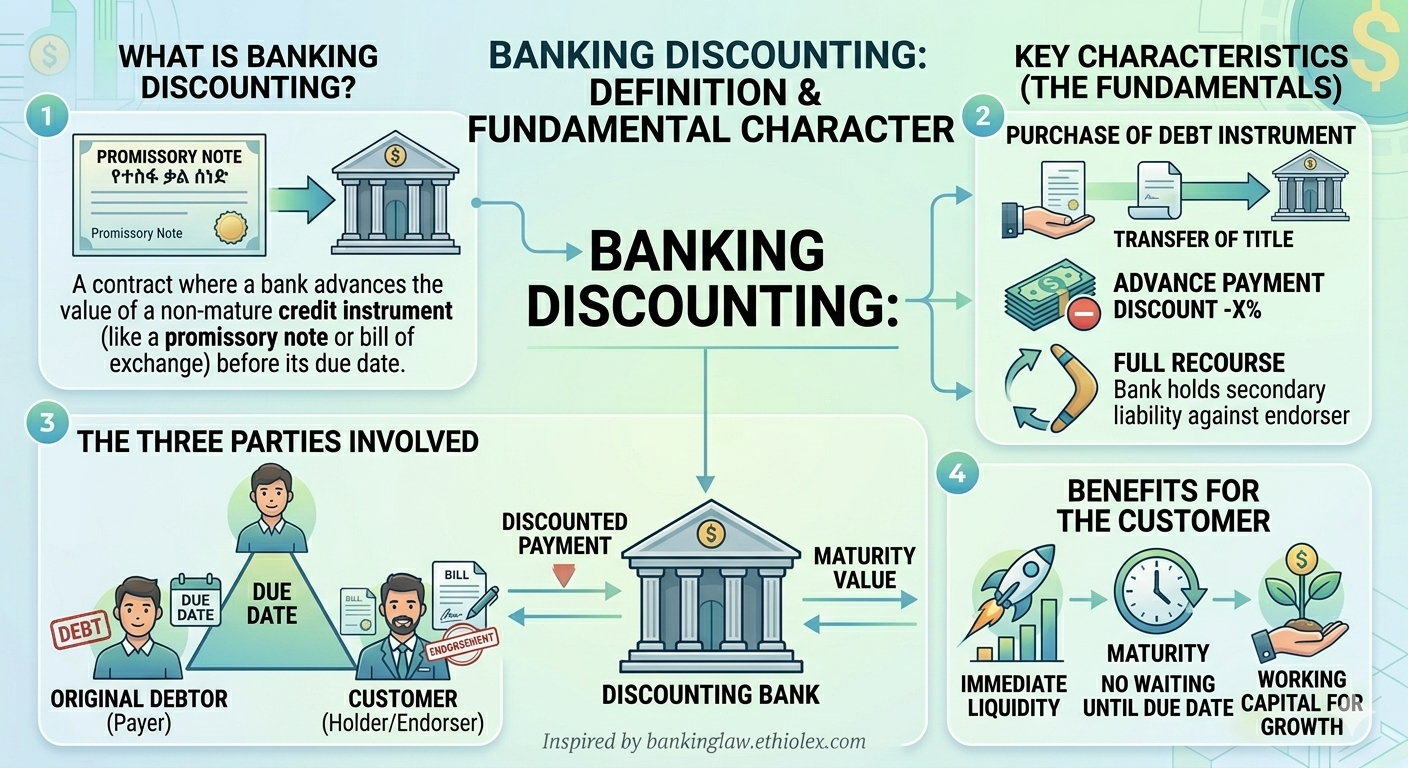

As defined in Article 941 of the Commercial Code, a discount is a specific contractual agreement where a banker provides an advance payment to a holder for the value of commercial instruments or other negotiable securities that have a fixed future date of payment. By entering into this arrangement, the holder assigns the instrument to the banker, effectively transferring the rights embodied in the title. This advance is conditional, as the transfer of value is made subject to the repayment of that value by the holder if the person principally liable on the instrument fails to make payment at maturity. This transaction creates a credit relationship that is secured by the underlying commercial paper while allowing the bank to generate revenue through professional fees. Furthermore, while the standard practice involves variable calculations, the law explicitly allows for special agreements that provide for a fixed discount rate.
Mechanics of Remuneration Through Interest and Commission
The economic benefit for the bank in a discount transaction is derived from the dual application of interest and commission charges. According to Article 942, interest is calculated based on the duration of the credit extended, specifically measured by the time remaining until the maturity of the instrument. In specialized instances, such as pawning transactions or where the beneficiary executes reimbursement before the instruments reach maturity, the interest may be calculated for a shorter, adjusted period. Beyond the time-value of money represented by interest, the bank is also entitled to an endorsing or other commission, which is calculated based on the total nominal value of the instruments themselves. To ensure the commercial viability of small-scale transactions, the law permits the parties to fix a minimum amount for both the interest and the commission charges.
Duties and Liabilities of the Beneficiary
The beneficiary of a discount transaction remains legally tethered to the ultimate performance of the underlying instrument. Article 943 stipulates that the beneficiary is under a strict statutory duty to reimburse the banker for the nominal value of any instruments or securities that remain unpaid by the primary obligor. This duty of reimbursement is proportional to the nature of the initial transaction; if a banker accepted instruments for discount for only a partial amount, the beneficiary’s liability for reimbursement is correspondingly limited to that specific partial amount. This framework ensures that the bank is protected against the insolvency or default of the primary debtor, as the beneficiary essentially acts as a secondary guarantor of the instrument's value.
Rights of the Banker and Recourse Mechanisms
The bank’s legal position following a discount is exceptionally robust, as it enjoys multiple avenues of recourse to recover the funds advanced. Under Article 944, the banker is empowered to exercise all rights arising directly out of the discounted instruments against the principal debtors, the beneficiary of the discount, and any other persons who are jointly and severally liable. In addition to these rights based on the instrument itself, the bank possesses a distinct contractual right against the beneficiary to seek reimbursement for the sums placed at their disposal, inclusive of all accrued interest and commissions. This separate right to reimbursement may be exercised regardless of the specific reasons for the non-payment of the instrument. Furthermore, when the parties maintain a current account relationship, the bank may utilize the contra transfer mechanisms provided in Articles 938 through 940 to adjust the account balance following a default, even after a remitter is declared bankrupt.